


What Is Safety Culture and Why It Matters More Than Your SWMS
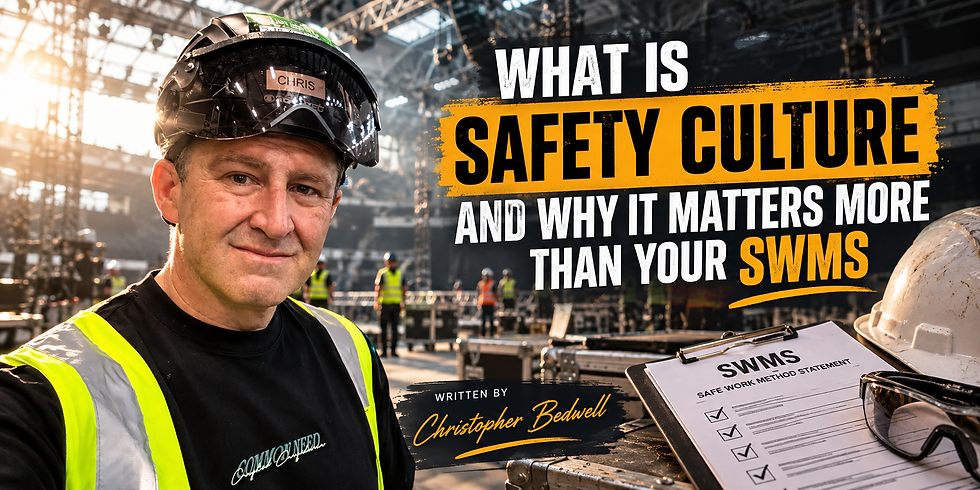
A worker can complete a SWMS perfectly, sign every form, attend the pre-start and still take a shortcut that puts themselves or someone else at risk.
That is the difference between safety compliance and safety culture.
A Safe Work Method Statement is important. So are inductions, permits, risk assessments, training records and emergency procedures. But paperwork only tells people what they are supposed to do.
Safety culture determines what people actually do when nobody is watching.
For businesses operating in construction, mining, utilities, maintenance and other high-risk industries across Western Australia, that distinction matters.
A strong workplace safety culture encourages workers to follow controls even when production pressure increases, report hazards and near misses, stop work when something does not look right, challenge unsafe behaviour and look after the rest of the crew.
What Is Safety Culture?
Safety culture is the shared attitude an organisation has towards health and safety.
It is often described simply as:
“The way we do things around here.”
You see it in everyday behaviour.
It is reflected in whether a worker completes a gas test properly before entering a confined space, whether a supervisor stops a job when conditions change, and whether an apprentice feels comfortable raising a concern with an experienced leading hand.
Safety culture becomes particularly obvious when deadlines start slipping, and people are under pressure.
A company may have excellent procedures on paper but still have a poor safety culture.
That happens when workers learn that production comes first, shortcuts are tolerated, hazards are ignored or speaking up creates problems.
Good safety culture exists when doing the job safely becomes the normal way of doing the job — rather than something people do only because a supervisor, client or auditor is watching.
Safety Culture vs Safety Compliance
Safety culture and safety compliance are closely related, but they are not the same thing.
Safety compliance means meeting legal duties and workplace requirements.
This includes SWMS, risk assessments, permits, licences, inductions, PPE requirements, emergency procedures, and supervision.
These systems are essential under Western Australia's WHS framework, but compliance is only one part of the picture.
Safety culture is the behaviour surrounding those systems.
For example, a SWMS may require workers to test the atmosphere before entering a confined space.
A compliant workplace has that requirement documented.
A workplace with a strong safety culture has a crew that would still perform the atmospheric test properly if the supervisor was nowhere to be seen.
That is the practical difference.
Compliance establishes the minimum standard. Culture determines whether that standard survives real-world pressure.
Why Your SWMS Is Not Enough on Its Own
A SWMS is an important risk-control document, particularly for high-risk construction work.
But a SWMS cannot physically stop somebody from taking a shortcut.
Problems begin when the SWMS becomes an administrative exercise rather than a working safety tool.
Workers may sign a SWMS without properly reading it. The same document may be reused despite changing conditions. Controls may be listed that are not actually available on site.
Sometimes everyone understands what the paperwork says, but the job is performed differently once work begins.
At that point, an organisation may have documentation, but it does not necessarily have effective risk management.
The strongest workplaces close the gap between what the procedure says and what workers actually do.
That means making the SWMS relevant to the job, involving the workers performing the task, checking that the proposed controls are practical and reviewing the document when circumstances change.
The Four Stages of Safety Culture
One commonly used way of describing safety culture maturity is the Bradley Curve.
It groups safety behaviour into four broad stages: Reactive, Dependent, Independent and Interdependent.
1. Reactive
In a reactive workplace, safety tends to become a priority only after something goes wrong.
Following an incident, the first question might be:
“Who caused this?”
Rather than:
“Why was our system able to allow this to happen?”
Common signs include low near-miss reporting, recurring problems, safety discussions that mainly follow incidents and a strong focus on individual blame.
The organisation reacts to safety problems rather than actively identifying the conditions likely to cause them.
2. Dependent
At the dependent stage, safety is mainly driven by rules and supervision.
Workers generally comply, but often because somebody is monitoring them.
PPE goes on when the supervisor arrives. The pre-start is completed because it is required. The paperwork is prepared in case the client audits it.
This is an improvement on a reactive culture, but it remains fragile.
The system depends heavily on supervisors enforcing the rules.
3. Independent
At the independent stage, workers begin taking personal responsibility for safety.
They understand the hazards associated with their work and apply controls because they understand why those controls matter.
An experienced worker may complete a proper pre-start despite schedule pressure.
A worker at height checks their connection point because they understand the consequences of getting it wrong.
A confined-space entrant confirms atmospheric testing before entry without needing somebody to remind them.
This is where training and experience begin to translate into consistent behaviour.
4. Interdependent
At the interdependent stage, safety becomes part of the team's identity.
Workers do not only protect themselves. They look after each other.
An apprentice can challenge an experienced worker. A crew member can stop a job. Workers raise hazards before they become incidents, and supervisors support people for speaking up.
Safety is no longer something management imposes.
It becomes part of how the team operates.
What Does a Strong Safety Culture Look Like on Site?
A healthy safety culture is usually visible long before you start reviewing the paperwork.
Leaders Follow the Same Rules
Leadership sends one of the strongest safety messages in any workplace.
If supervisors bypass procedures, workers notice.
If managers prioritise deadlines over safety, workers notice that too.
The reverse is equally true.
When leaders stop work when necessary, wear the correct PPE, complete required checks and support workers who raise concerns, expectations become much clearer.
Workers tend to follow what leaders do, not simply what policies say.
Workers Are Comfortable Speaking Up
A strong workplace allows workers to raise concerns without worrying about retaliation, embarrassment or being labelled a troublemaker.
That includes reporting:
hazards
near misses
fatigue
changed conditions
defective equipment
unsafe behaviour.
The important question is what management does with that information.
If workers repeatedly report problems and nothing happens, they eventually stop reporting them.
If concerns are acknowledged and acted upon, confidence in the system grows.
Incidents Lead to Learning
Strong organisations do more than file incident reports.
They ask:
What happened?
Why did it happen?
What controls failed?
Did production pressure contribute?
Could the same problem exist somewhere else?
Then they share what they have learned.
That creates an improvement cycle rather than an administration cycle.
Safety Culture in High-Risk Work
Safety culture matters in every workplace, but it is especially important in high-risk environments, where the consequences of poor decisions can be severe.
Consider confined-space entry.
A procedure may require atmospheric testing, a permit, standby personnel, communications and a rescue plan.
But those controls only work if everyone involved understands why they exist and consistently applies them.
The same principle applies to working at heights.
A harness may be onsite, and the worker may have completed training.
But the real questions are whether the worker understands where they can connect, whether the anchorage is suitable, whether there is sufficient fall clearance and what will happen if somebody falls and becomes suspended.
Having equipment and paperwork is only part of the system.
Competence and behaviour complete it.
Shutdowns and Outages Put Safety Culture Under Pressure
Shutdowns and outages are particularly good at exposing the real safety culture of an organisation.
They commonly involve tight deadlines, large contractor workforces, unfamiliar workers, simultaneous operations, fatigue and production pressure.
That combination can create conditions in which shortcuts gradually become the norm.
A procedure starts becoming:
“We normally do it this way.”
Then:
“We did it last time, and nothing happened.”
That is how unsafe practices can become accepted.
A strong safety culture challenges those behaviours early.
Workers are expected to stop, reassess and escalate when actual conditions no longer match the original plan.
For remote Western Australian operations, the stakes may be even higher.
Emergency services may be further away. Medical assistance can be limited. Crews may be smaller, and supervision may cover very large areas.
That makes prevention even more important.
Training Has to Build Competence, Not Attendance
Training does not automatically create a good safety culture.
But good training helps build one.
The purpose of competency-based training should not simply be to issue a certificate.
Workers should understand the hazard, why the control exists, how to apply that control, how to recognise when conditions have changed and when the job needs to stop.
For confined-space work, workers should understand how to identify the space, interpret a permit, test the atmosphere, monitor conditions, communicate effectively, use the required equipment and respond when conditions change.
For working at heights, workers need practical understanding of fall hazards, equipment, anchorage, clearance and emergency considerations.
The goal should always be:
Competent behaviour — not simply attendance.
Supervisors and Leaders Need Safety Knowledge Too
Safety training is often concentrated on frontline workers.
But supervisors, planners and managers also make decisions that directly influence workplace safety.
They determine available time, equipment, staffing, sequencing, contractor selection and emergency arrangements.
If those people do not understand the hazards associated with the work, poor decisions can be built into the job before workers even arrive onsite.
A strong safety culture, therefore,e begins well before somebody puts on a harness, enters a confined space,e or starts a piece of equipment.
Psychosocial Safety Is Part of Safety Culture
Modern WHS management also needs to consider psychosocial hazards.
These may include excessive workload, fatigue, bullying, poor workplace relationships, isolation, exposure to traumatic events, unclear responsibilities and job insecurity.
Fatigue can affect judgement.
Poor communication can prevent hazards from being raised.
An aggressive management style can create an environment where workers remain silent rather than challenge an unsafe decision.
A strong workplace safety culture needs to consider these risks alongside traditional physical hazards.
How to Improve Safety Culture in Your Workplace
Improving safety culture does not necessarily require another large policy manual.
It usually starts with behaviour.
1. Look Honestly at Leadership
Ask what happens when safety and production conflict.
Do supervisors genuinely support stopping work?
Do leaders apply the same rules they expect workers to follow?
Those answers can tell you more about your organisation than many formal audits.
2. Make Hazard Reporting Worthwhile
Workers quickly stop reporting problems when nothing happens afterwards.
When somebody raises a concern:
Acknowledge it. Investigate it. Act on it. Communicate the outcome.
Closing that feedback loop builds trust.
3. Invest in Competency
Training should build capability, not simply satisfy a client requirement.
Workers dealing with significant hazards need the practical knowledge and skills to manage them properly.
4. Rehearse Emergency Arrangements
A rescue or emergency plan should not exist only in a folder.
Test it.
Who performs the rescue?
What equipment is available?
Can it be deployed quickly?
Has the plan actually been practised?
The middle of an emergency is a poor time to discover that your rescue plan does not work.
5. Talk About the Work That Is Actually Happening
Generic safety messages quickly lose their impact.
Toolbox meetings and pre-start discussions should address the work actually happening on site.
What changed today?
What nearly went wrong yesterday?
Where are workers having difficulty?
What are people worried about?
Those conversations are far more useful than simply repeating safety slogans.
Safety Culture and SWMS Should Work Together
None of this means SWMS are unimportant.
Quite the opposite.
A well-prepared SWMS is an important part of planning and controlling high-risk work.
But its effectiveness depends on the culture surrounding it.
The strongest workplaces combine:
Good documentation + competent workers + effective supervision + strong leadership + open communication.
Remove any one of those elements and the overall system becomes weaker.
The Bottom Line
Your SWMS tells workers what should happen.
Your safety culture determines what actually happens.
The strongest safety cultures are built when workers understand the risks, leaders demonstrate the right behaviour, and people feel comfortable speaking up when something is wrong.
That matters particularly in high-risk environments involving confined spaces, working at heights, shutdowns, industrial maintenance and emergency response.
Paperwork remains important.
But paperwork cannot replace competence, leadership and good judgement.
Safety is not simply a form somebody signs. It is behaviour that has to be demonstrated every day.
High-Risk Training in Western Australia
Safety Heights and Rescue Training — RTO 52610 provides practical, nationally recognised training for workers operating in high-risk environments across Western Australia.
Our training includes core areas such as confined space entry, working safely at heights, gas testing and breathing apparatus.
Our focus is practical competency — helping workers understand not only what a safety control requires, but why it matters when they return to the workplace.
If your organisation wants to strengthen worker competency and build safer behaviour onsite, speak to Safety Heights about training for your workforce.
Frequently Asked Questions About Safety Culture
What is safety culture?
Safety culture is the shared attitudes, values, and behaviours that determine how an organisation manages workplace health and safety in its day-to-day operations.
What is the difference between safety culture and safety compliance?
Compliance involves meeting legal and procedural requirements. Safety culture relates to how workers and leaders actually behave, particularly when they are not being directly supervised.
Can a workplace be compliant but still have a poor safety culture?
Yes. A workplace can have SWMS, policies, procedures, and training records, yet workers still take shortcuts, fail to report hazards, or ignore controls.
How can employers improve workplace safety culture?
Start with leadership behaviour, encourage hazard reporting, respond to concerns, invest in worker competency, discuss genuine workplace risks and regularly test emergency arrangements.
Why is safety culture important in high-risk work?
In high-risk work, relatively small behavioural failures can have serious consequences. A strong safety culture helps ensure controls continue to be applied consistently, including during periods of time pressure, fatigue or increased production demands.

Comments